See also:
U+673A, 机
CJK UNIFIED IDEOGRAPH-673A

[U+6739]
CJK Unified Ideographs
[U+673B]

Translingual

Stroke order
0 strokes
Japanese 机∣
Simplified
Traditional 机∣

Han character

(Kangxi radical 75, +2, 6 strokes, cangjie input 木竹弓 (DHN), four-corner 47910, composition )

Derived characters

  • 𣌯, 𦊵, 𪳴, 𩍊

References

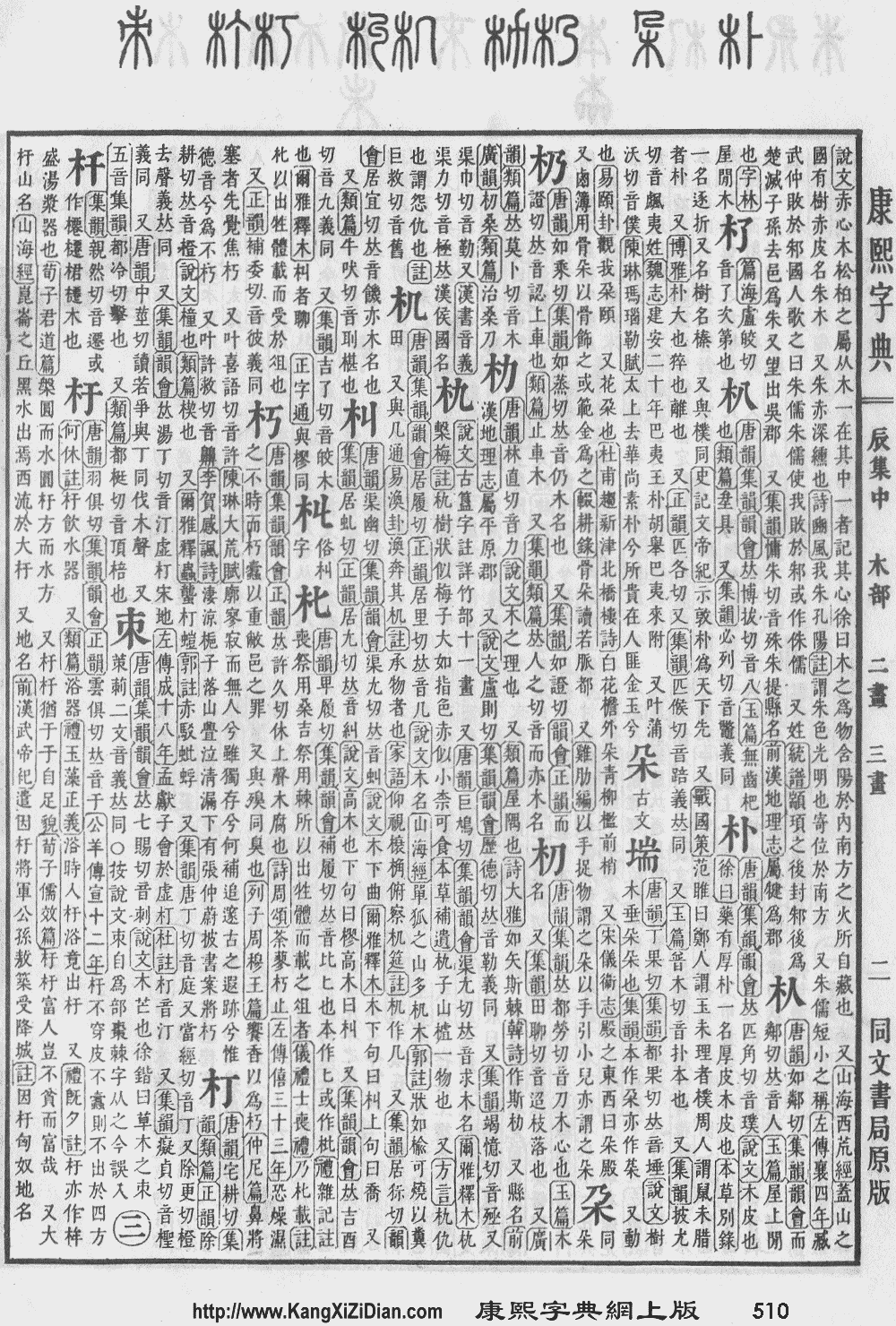
  • Kangxi Dictionary: page 510, character 12
  • Dai Kanwa Jiten: character 14435
  • Hanyu Da Zidian (first edition): volume 2, page 1155, character 4
  • Unihan data for U+673A

Usage notes

Note that in Japanese, traditional Chinese, and Korean, both and are used with separate meanings (: desk and : machine; airplane; chance) while in simplified Chinese, 机 is the simplified form of .

Chinese

Glyph origin

Phono-semantic compound (形聲形声, OC *kril, *krilʔ) : semantic (tree; wood) + phonetic (OC *krilʔ).

Etymology 1

For pronunciation and definitions of – see (“weaving machine; spinning machine; machine; apparatus; device; etc.”).
(This character, , is the simplified and variant form of ).
Notes:

Etymology 2

simp. and trad.

Pronunciation


Note: gei2 - variant.

Rime
Character
Reading # 1/2 2/2
Initial () (28) (28)
Final () (15) (15)
Tone (調) Level (Ø) Rising (X)
Openness (開合) Open Open
Division () III III
Fanqie
Baxter kjij kjijX
Reconstructions
Zhengzhang
Shangfang
/kiɪ/ /kiɪX/
Pan
Wuyun
/ki/ /kiX/
Shao
Rongfen
/kjɪ/ /kjɪX/
Edwin
Pulleyblank
/ki/ /kiX/
Li
Rong
/ki/ /kiX/
Wang
Li
/ki/ /kiX/
Bernard
Karlgren
/ki/ /kiX/
Expected
Mandarin
Reflex
Expected
Cantonese
Reflex
gei1 gei2
BaxterSagart system 1.1 (2014)
Character
Reading # 1/1
Modern
Beijing
(Pinyin)
Middle
Chinese
‹ kijX ›
Old
Chinese
/*krəjʔ/
English small table, stool

Notes for Old Chinese notations in the Baxter–Sagart system:

* Parentheses "()" indicate uncertain presence;
* Square brackets "[]" indicate uncertain identity, e.g. *[t] as coda may in fact be *-t or *-p;
* Angle brackets "<>" indicate infix;
* Hyphen "-" indicates morpheme boundary;

* Period "." indicates syllable boundary.
Zhengzhang system (2003)
Character
Reading # 1/2 2/2
No. 5758 5761
Phonetic
component
Rime
group
Rime
subdivision
1 1
Corresponding
MC rime
Old
Chinese
/*kril/ /*krilʔ/

Definitions

  1. Alternative form of (small table; stool)
  2. alder
  3. a surname

Pronunciation


Definitions

  1. chopping board

Japanese

Kanji

(grade 6 “Kyōiku” kanji)

  1. desk, table

Readings

Compounds

Etymology

Kanji in this term
つくえ
Grade: 6
kun’yomi
Alternative spellings
つくえ

(This etymology is missing or incomplete. Please add to it, or discuss it at the Etymology scriptorium.)

Pronunciation

  • (Tokyo) くえ [tsùkúé] (Heiban – [0])[1]
  • IPA(key): [t͡sɨᵝkɯ̟ᵝe̞]

Noun

(つくえ) • (tsukue) 

  1. desk; table
    (つくえ)(うえ)(ほん)(さん)(さつ)ある
    Tsukue no ue ni hon ga sansatsu aru.
    There are three books on the desk.

Usage notes

In pre-WWII literature, the historical kana spelling was mistaken to be つくゑ. Sources from the Heian period show つくえ, which is now accepted as correct.

References

  1. 2006, 大辞林 (Daijirin), Third Edition (in Japanese), Tōkyō: Sanseidō, →ISBN

Korean

Hanja

• (gwe) (hangeul , revised gwe, McCuneReischauer kwe, Yale kwey)

  1. desk

Vietnamese

Han character

: Hán Nôm readings:

  1. This term needs a translation to English. Please help out and add a translation, then remove the text {{rfdef}}.
This article is issued from Wiktionary. The text is licensed under Creative Commons - Attribution - Sharealike. Additional terms may apply for the media files.