cam
English
Pronunciation
- IPA(key): [kæm]
Audio (Southern England) (file) - Rhymes: -æm
Etymology 1
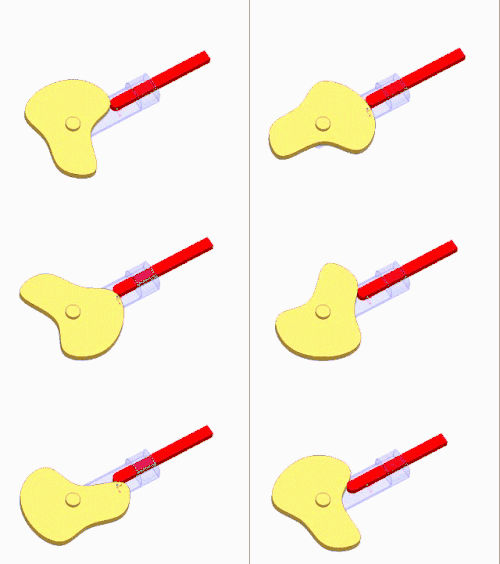
Recorded since the 16th century, from Dutch kam (“cog of a wheel; originally, comb”) (cognate with English comb, and preserved in modern Dutch compounds such as kamrad, kamwiel (“cog wheel”)). Doublet of comb.
Noun
cam (plural cams)
- A turning or sliding piece which imparts motion to a rod, lever or block brought into sliding or rolling contact with it.
- A curved wedge, movable about an axis, used for forcing or clamping two pieces together.
- (UK, dialect) A ridge or mound of earth.
- 1861, Dean Ramsay, Reminiscences of Scottish Life and Character:
- Cum doun t' cam' soid
- (climbing) A spring-loaded camming device, a spring-loaded device for effecting a temporary belay in a rock crevice.
Descendants
- → Welsh: cam
Translations
|
See also
 cam on Wikipedia.Wikipedia
 - Spring-loaded camming device on Wikipedia.Wikipedia
Etymology 2
Clipping of camera.
Derived terms
Translations
Verb
cam (third-person singular simple present cams, present participle camming, simple past and past participle cammed)
- To go on webcam with someone.
Further reading
- “cam”, in Webster’s Revised Unabridged Dictionary, Springfield, Mass.: G. & C. Merriam, 1913, →OCLC.
See also
Acholi
Caló
Chinese
Pronunciation
Noun
cam
Synonyms
Galician
References
- “cam” in Dicionário Estraviz de galego (2014).
Indonesian
Etymology
From Malay cam. From Sanskrit [Term?]. Compare Urak Lawoi' จับ (cap, “to remember”).
Pronunciation
- IPA(key): /ˈt͡ʃam/, [ˈt͡ʃam]
Derived terms
- camkan
- dicamkan
- mengecamkan
- pengecaman
Further reading
- “cam” in Kamus Besar Bahasa Indonesia, Jakarta: Language Development and Fostering Agency — Ministry of Education, Culture, Research, and Technology of the Republic Indonesia, 2016.
Irish
Pronunciation
Adjective
cam (genitive singular masculine caim, genitive singular feminine caime, plural cama, comparative caime)
Declension
| Singular | Plural (m/f) | |||
|---|---|---|---|---|
| Positive | Masculine | Feminine | (strong noun) | (weak noun) |
| Nominative | cam | cham | cama; chama² | |
| Vocative | chaim | cama | ||
| Genitive | caime | cama | cam | |
| Dative | cam; cham¹ |
cham; chaim (archaic) |
cama; chama² | |
| Comparative | níos caime | |||
| Superlative | is caime | |||
¹ When the preceding noun is lenited and governed by the definite article.
² When the preceding noun ends in a slender consonant.
Derived terms
- caime f (“crookedness”)
- cam-mhuin f (“wryneck”)
- camchosach (“bandy-legged”, adjective)
Descendants
- → Yola: caam
Mutation
| Irish mutation | ||
|---|---|---|
| Radical | Lenition | Eclipsis |
| cam | cham | gcam |
| Note: Some of these forms may be hypothetical. Not every possible mutated form of every word actually occurs. | ||
Further reading
- Ó Dónaill, Niall (1977), “cam”, in Foclóir Gaeilge–Béarla, Dublin: An Gúm, →ISBN
Malay
Etymology
From Sanskrit [Term?]. Compare Urak Lawoi' จับ (cap, “to remember”).
Pronunciation
- IPA(key): /ˈt͡ʃam/, [ˈt͡ʃam]
Verb
cam (Jawi spelling چم)
Derived terms
Irregular affixed derivations, other derivations and compound words:
- pengecaman
- camkan
- mengecamkan
- dicamkan
Descendants
- Indonesian: cam
Further reading
- “cam” in Pusat Rujukan Persuratan Melayu | Malay Literary Reference Centre, Kuala Lumpur: Dewan Bahasa dan Pustaka, 2017.
Manx
Verb
Old Irish
Declension
| o/ā-stem | |||
|---|---|---|---|
| Singular | Masculine | Feminine | Neuter |
| Nominative | cam | cam | cam |
| Vocative | caim* cam** | ||
| Accusative | cam | caim | |
| Genitive | caim | caime | caim |
| Dative | cam | caim | cam |
| Plural | Masculine | Feminine/neuter | |
| Nominative | caim | cama | |
| Vocative | camu cama† | ||
| Accusative | camu cama† | ||
| Genitive | cam | ||
| Dative | camaib | ||
| Notes | *modifying a noun whose vocative is different from its nominative **modifying a noun whose vocative is identical to its nominative | ||
Romanian
Pronunciation
Audio (file)
Related terms
Scots
Scottish Gaelic
Pronunciation
- IPA(key): /kaːm/, /kʰaum/
Turkish
Etymology
From Ottoman Turkish جام (cam), from Persian جام (jâm).
Pronunciation
- IPA(key): /dʒam/
Audio (file)
Noun
cam (definite accusative camı, plural camlar)
Derived terms
Vietnamese
Etymology 1
Sino-Vietnamese word from 柑 (“orange”).
Pronunciation
- (Hà Nội) IPA(key): [kaːm˧˧]
- (Huế) IPA(key): [kaːm˧˧]
- (Hồ Chí Minh City) IPA(key): [kaːm˧˧]
Noun
(classifier cây, trái, quả) cam
- orange, such as or citrus sinensis sinensis or citrus aurantium
- Short for cam sành (“Citrus reticulata × sinensis”).
See also
| trắng | xám | đen |
| đỏ; thắm, thẫm | cam; nâu | vàng; kem |
| vàng chanh | xanh, xanh lá cây, xanh lục, lục | xanh bạc hà; xanh lục đậm |
| xanh lơ, hồ thuỷ; xanh mòng két | xanh, xanh da trời, thiên thanh | xanh, xanh dương, xanh nước biển, xanh lam, lam |
| tím; chàm | tía | hồng |
Welsh
Pronunciation
- IPA(key): /kam/
Etymology 1
From Proto-Celtic *kanksman, *kanxsman, from *kengeti.
Noun
cam m (plural camau)
Derived terms
Etymology 2
From Proto-Brythonic *kam, from Proto-Celtic *kambos.
Adjective
cam (feminine singular cam, plural ceimion, equative camed, comparative camach, superlative camaf)
Derived terms
Yola
Verb
cam
- simple past tense of coome
- 1927, “PAUDEEN FOUGHLAAN'S WEDDEEN”, in THE ANCIENT DIALECT OF THE BARONIES OF FORTH AND BARGY, COUNTY WEXFORD, page 133, line 5:
- Yola Vather Deruse hay raree cam thoare,
- Old Father Devereux early came there,
References
- Kathleen A. Browne (1927) The Journal of the Royal Society of Antiquaries of Ireland Sixth Series, Vol.17 No.2, Royal Society of Antiquaries of Ireland, page 133
Zhuang
Etymology
From Proto-Tai *c.raːmᴬ (“to ask”). Cognate with Thai ถาม (tǎam), Northern Thai ᨳᩣ᩠ᨾ, Lao ຖາມ (thām), Lü ᦏᦱᧄ (ṫhaam), Shan ထၢမ် (thǎam), Ahom 𑜌𑜪 (thaṃ), 𑜌𑜉𑜫 (tham) or 𑜌𑜢𑜤𑜉𑜫 (thüm), Saek ถ่าม.
Pronunciation
- (Standard Zhuang) IPA(key): /ɕaːm˨˦/
- Tone numbers: cam1
- Hyphenation: cam