See also:
U+8EDB, 軛
CJK UNIFIED IDEOGRAPH-8EDB

[U+8EDA]
CJK Unified Ideographs
[U+8EDC]

Translingual

Han character

(Kangxi radical 159, +4, 11 strokes, cangjie input 十十一尸山 (JJMSU), four-corner 51012, composition )

References

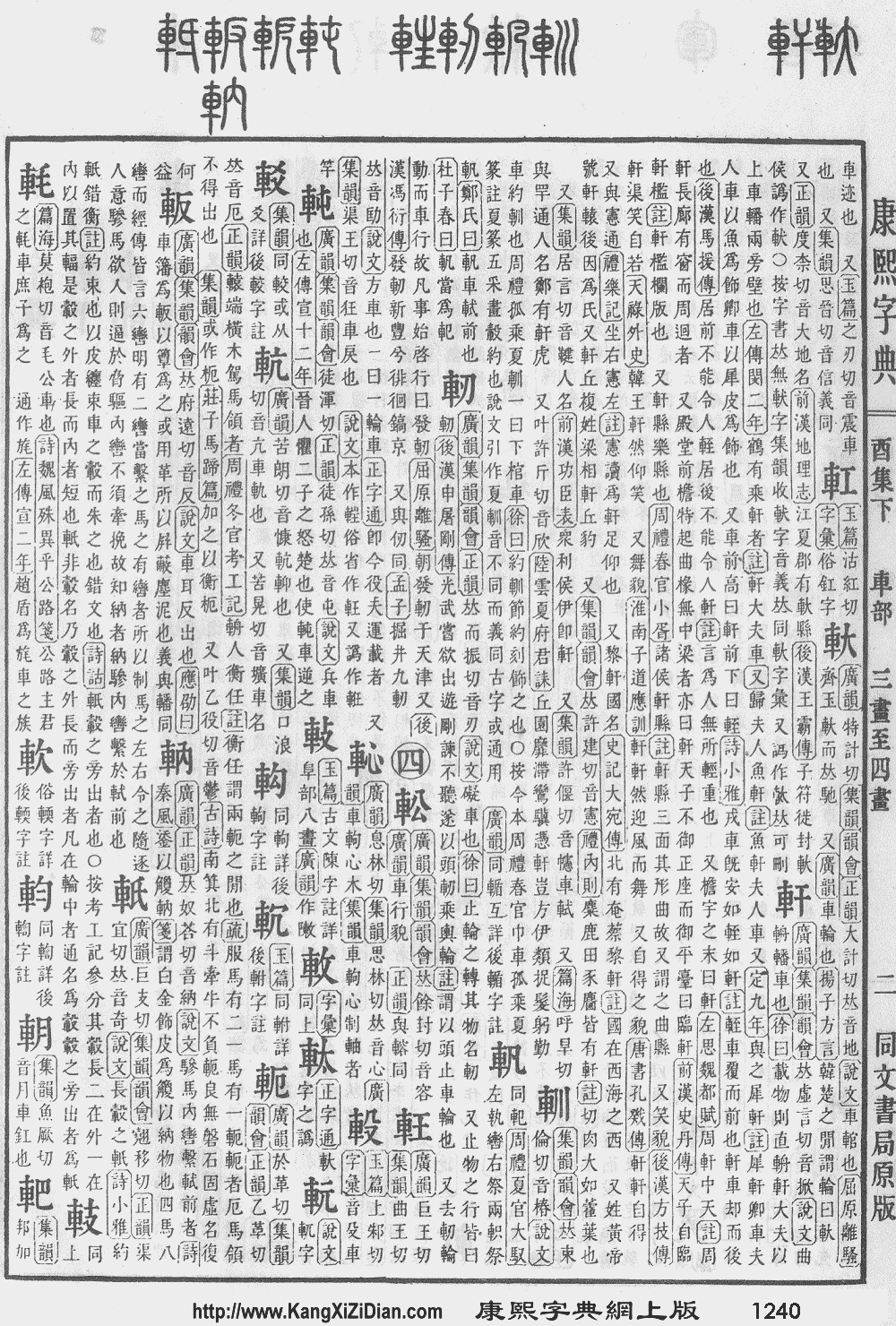
  • Kangxi Dictionary: page 1240, character 20
  • Dai Kanwa Jiten: character 38207
  • Dae Jaweon: page 1716, character 16
  • Hanyu Da Zidian (first edition): volume 5, page 3517, character 8
  • Unihan data for U+8EDB

Chinese

Lua error in Module:utilities at line 142: attempt to perform arithmetic on local 'h' (a nil value)

Glyph origin

Ideogrammic compound (會意会意) and phono-semantic compound (形聲形声, OC *qreːɡ) : semantic (chariot) + phonetic (OC *qreːɡ, yoke) – specialized form of .

Etymology

Probably from Proto-Sino-Tibetan *ʔik (to strangle), whence also (OC *qleːɡs, *qleɡs, “to strangle”).

Pronunciation


Note: The zero initial /∅-/ is commonly pronounced with a ng-initial /ŋ-/ in some varieties of Cantonese, including Hong Kong Cantonese.
Note:
  • Xiamen, Quanzhou:
    • eh - vernacular;
    • ek/iak - literary.
Note:
  • nga4 - vernacular;
  • nge6 - literary.

Rime
Character
Reading # 1/1
Initial () (34)
Final () (119)
Tone (調) Checked (Ø)
Openness (開合) Open
Division () II
Fanqie
Baxter 'eak
Reconstructions
Zhengzhang
Shangfang
/ʔˠɛk̚/
Pan
Wuyun
/ʔᵚæk̚/
Shao
Rongfen
/ʔɐk̚/
Edwin
Pulleyblank
/ʔəɨjk̚/
Li
Rong
/ʔɛk̚/
Wang
Li
/æk̚/
Bernard
Karlgren
/ʔæk̚/
Expected
Mandarin
Reflex
e
Expected
Cantonese
Reflex
ak1
BaxterSagart system 1.1 (2014)
Character
Reading # 1/1
Modern
Beijing
(Pinyin)
è
Middle
Chinese
‹ ʔɛk ›
Old
Chinese
/*qˁ<r>[i]k/
English part of a yoke

Notes for Old Chinese notations in the Baxter–Sagart system:

* Parentheses "()" indicate uncertain presence;
* Square brackets "[]" indicate uncertain identity, e.g. *[t] as coda may in fact be *-t or *-p;
* Angle brackets "<>" indicate infix;
* Hyphen "-" indicates morpheme boundary;

* Period "." indicates syllable boundary.
Zhengzhang system (2003)
Character
Reading # 1/1
No. 2711
Phonetic
component
Rime
group
Rime
subdivision
0
Corresponding
MC rime
Old
Chinese
/*qreːɡ/
Notes

Definitions

  1. yoke
  2. to restrain; to control

Compounds

  • 亢軛亢轭
  • 偏轉軛偏转轭
  • 共軛弧共轭弧
  • 共軛複數共轭复数 (gòng'è fùshù)
  • 共軛角共轭角
  • 共軛雙曲線共轭双曲线
  • 共軛鹼共轭碱 (gòng'èjiǎn)
  • 牛軛牛轭 (niú'è)
  • 牛軛湖牛轭湖
  • 犁軛犁轭
  • 狖軛鼯軒狖轭鼯轩
  • 琱軛雕轭
  • 羈軛羁轭
  • 衡軛衡轭
  • 複共軛的复共轭的
  • 負軛负轭
  • 車軛车轭
  • 軛束轭束
  • 軛縛轭缚
  • 輪軛轮轭
  • 轅軛辕轭
  • 銜軛衔轭
  • 鞅軛鞅轭
  • 頓軛顿轭
  • 馬軛马轭

Descendants

References

Japanese

Kanji

(uncommon “Hyōgai” kanji)

Readings

  • On (unclassified): あく (aku); やく (yaku)
  • Kun: くびき (kubiki)

Etymology

Kanji in this term
くびき
Hyōgaiji
kun’yomi
For pronunciation and definitions of – see the following entry.
くびき
[noun] yoke (wooden bar)
Alternative spellings
, 頸木
(This term, , is an alternative spelling of the above term.)
This article is issued from Wiktionary. The text is licensed under Creative Commons - Attribution - Sharealike. Additional terms may apply for the media files.