石榴
Chinese
Lua error in Module:utilities at line 142: attempt to perform arithmetic on local 'h' (a nil value)
Etymology
Short for 安石榴 (ānshíliú); see there for more.
Pronunciation
Lua error in Module:utilities at line 142: attempt to perform arithmetic on local 'h' (a nil value)

Synonyms
Lua error in Module:utilities at line 142: attempt to perform arithmetic on local 'h' (a nil value) Lua error in Module:utilities at line 142: attempt to perform arithmetic on local 'h' (a nil value)
Further reading
- Ding, Fubao (丁福保) (1922),
 “石榴” in 佛學大辭典 [A Dictionary of Chinese Buddhist Terms].
Japanese
.jpg.webp)
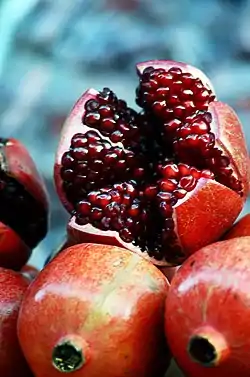
Etymology 1
From Middle Chinese 石榴 (MC dzyek ljuw, literally “stone + pomegranate”). Compare modern Wu reading zaq lieu, Hakka sa̍k-liù.
The zakuro reading is irregular. This may represent a shift in pronunciation from an older borrowing: compare the expected goon reading jakuru. Alternatively, this reading may reflect an ancient sound borrowing, indicating the Zagros Mountains of modern-day Iran, where the pomegranate was originally cultivated.[1]
The spelling 柘榴 is attested in 747 CE.[2] The zakuro reading is attested to at least the late 900s in the 古今和歌六帖 (Kokin Waka Rokujō, “Six Volumes of Waka Poetry of Ancient and Modern Times”).[2]
Usage notes
As with many terms that name organisms, this term is often spelled in katakana, especially in biological contexts (where katakana is customary), as ザクロ.
Derived terms
- 石榴石 (zakuroishi): garnet (gemstone)
- 石榴口 (zakuroguchi): a low door used in bathhouses during the Edo period
- 石榴ざか (zakurozaka): a rooster's crest or comb that resembles a pomegranate
- 石榴草 (zakurosō): Mollugo pentaphylla
- 石榴鼻 (zakurobana): a red swollen nose, often seen on alcoholics
Etymology 2
From Middle Chinese 石榴 (MC dzyek ljuw, literally “stone + pomegranate”). Uses the regular goon reading of jaku for the first character, and the irregular ro reading for the second character instead of the expected goon reading of ru.
The jakuro reading is attested from the mid-1400s.[2] While rare and missing from some dictionaries,[3][5] this reading is attested more recently in a text from the 1960s.[2]
Pronunciation
- IPA(key): [d͡ʑa̠kɯ̟ᵝɾo̞]
Usage notes
The zakuro reading above is the most common reading for this term.
Etymology 3
| Kanji in this term | |
|---|---|
| 石 | 榴 |
| せき Grade: 1 |
りゅう Hyōgaiji |
| kan’on | |
/sekiriu/ → /sekirjuː/
From Middle Chinese 石榴 (MC dzyek ljuw, literally “stone + pomegranate”). Uses the regular kanon reading of both characters.
The sekiriu reading is attested from the mid-1400s.[2]
Usage notes
The zakuro reading above is the most common reading for this term.
Derived terms
References
- 清水桂一 (Keiichi Shimizu), editor (1980) たべもの語源辞典 (Tabemono Gogen Jiten, “Etymological Dictionary of Foods”) (in Japanese), 東京堂出版 (Tōkyō-dō Shuppan, “Tokyo Hall Publishing”), →ISBN, archived from the original on 2021-06-06
- 1988, 国語大辞典(新装版) (Kokugo Dai Jiten, Revised Edition) (in Japanese), Tōkyō: Shogakukan
- 2006, 大辞林 (Daijirin), Third Edition (in Japanese), Tōkyō: Sanseidō, →ISBN
- 1998, NHK日本語発音アクセント辞典 (NHK Japanese Pronunciation Accent Dictionary) (in Japanese), Tōkyō: NHK, →ISBN
- 1997, 新明解国語辞典 (Shin Meikai Kokugo Jiten), Fifth Edition (in Japanese), Tōkyō: Sanseidō, →ISBN
Okinawan
| Kanji in this term | |
|---|---|
| 石 | 榴 |
| Grade: 1 | Hyōgaiji |
Etymology
Attested in the 沖縄語典 (Okinawa Goten, “Okinawan Dictionary”) as ざぐら.[1] Appears to be cognate with Japanese Lua error in Module:utilities at line 142: attempt to perform arithmetic on local 'h' (a nil value); see that entry for further details.
References
- 1896: 沖縄語典 (Okinawa Goten, “Okinawan Dictionary”). In Japanese. http://kindai.ndl.go.jp/info:ndljp/pid/992016/43