戔
| ||||||||
Translingual
| Traditional | Lua error in Module:utilities at line 142: attempt to perform arithmetic on local 'h' (a nil value) |
|---|---|
| Shinjitai (extended) |
㦮 |
| Simplified | 戋 |
Han character
戔 (Kangxi radical 62, 戈+4, 8 strokes, cangjie input 戈戈 (II), four-corner 53503, composition ⿱戈戈)
Derived characters
Descendants
References
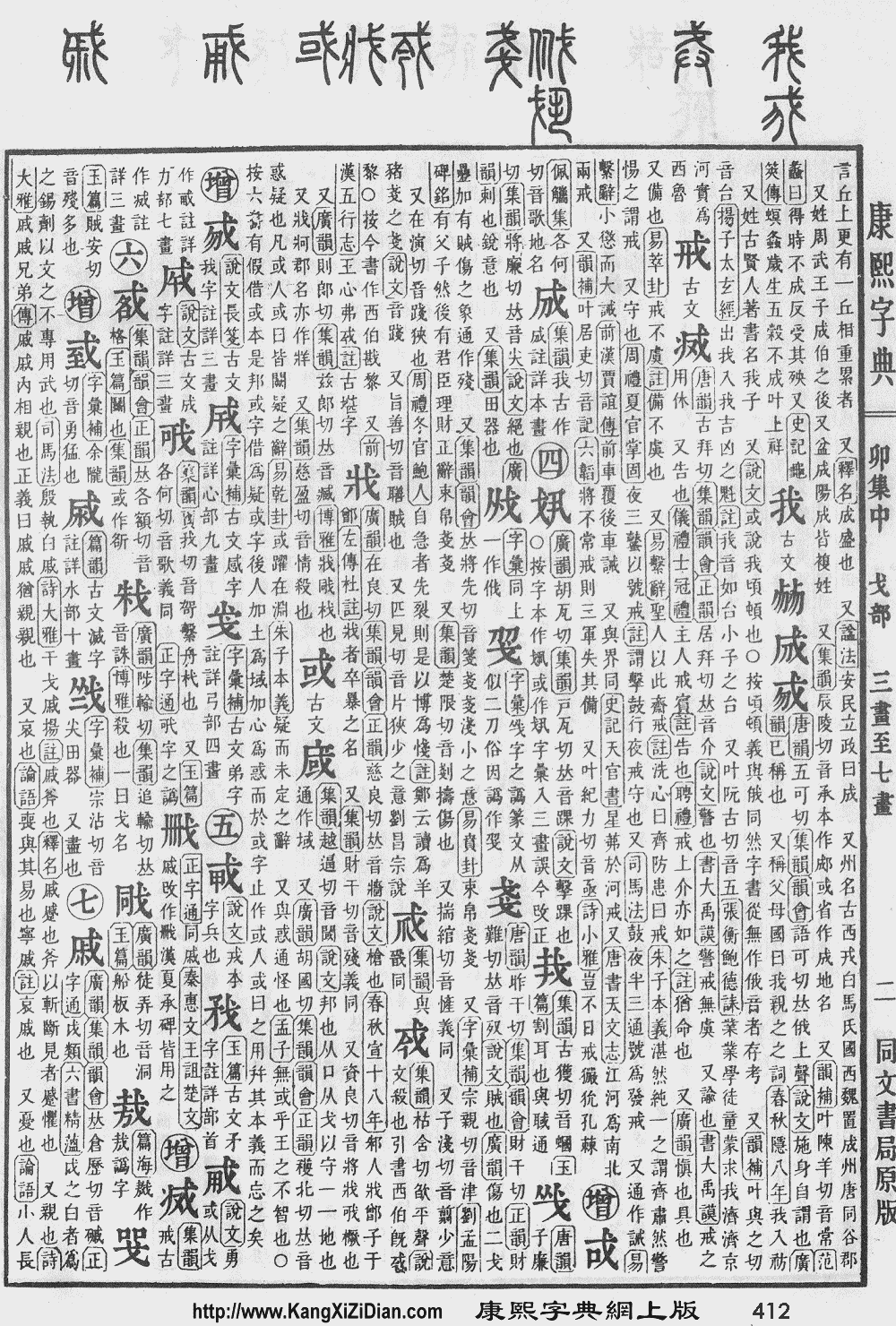
- Kangxi Dictionary: page 412, character 14
- Dai Kanwa Jiten: character 11559
- Dae Jaweon: page 754, character 12
- Hanyu Da Zidian (first edition): volume 2, page 1402, character 6
- Unihan data for U+6214
Chinese
Lua error in Module:utilities at line 142: attempt to perform arithmetic on local 'h' (a nil value)
Glyph origin
| Historical forms of the character 戔 | |
|---|---|
| Shang | Shuowen Jiezi (compiled in Han) |
| Oracle bone script | Small seal script |
 |
 |
Characters in the same phonetic series (戔) (Zhengzhang, 2003)
| Old Chinese | |
|---|---|
| 殘 | *zlaːn, *zaːns |
| 戔 | *zlaːn |
| 帴 | *zlaːn, *saːns, *ʔslenʔ, *ʔsleːn, *sreːd |
| 虥 | *zreːn, *zreːn, *zreːnʔ, *zraːns |
| 盞 | *ʔsreːnʔ |
| 醆 | *ʔsreːnʔ, *ʔljenʔ |
| 琖 | *ʔsreːnʔ |
| 剗 | *sʰreːnʔ |
| 棧 | *zreːnʔ, *zraːns, *zrenʔ |
| 輚 | *zreːnʔ, *zraːns |
| 嶘 | *zreːnʔ |
| 錢 | *ʔslenʔ, *zlen |
| 俴 | *ʔslenʔ, *zlenʔ |
| 籛 | *ʔslenʔ, *ʔslens, *ʔsleːn |
| 淺 | *sʰlenʔ, *ʔsleːn |
| 濺 | *ʔsens, *ʔseːn |
| 踐 | *zlenʔ |
| 諓 | *zlenʔ, *zlens |
| 餞 | *zlenʔ, *zlens |
| 賤 | *zlens |
| 綫 | *slens |
| 箋 | *ʔsleːn |
| 牋 | *ʔsleːn |
Pronunciation
Definitions
戔
- Original form of 殘/残 (cán, “to harm; to injure”).
- Used in 戔戔/戋戋 (jiānjiān, “the appearance of being small; the appearance of accumulation”).
Japanese
Kanji
戔
(uncommon “Hyōgai” kanji, kyūjitai kanji, shinjitai form 㦮)
- This term needs a translation to English. Please help out and add a translation, then remove the text
{{rfdef}}.
Korean
Hanja
戔 (eum 잔 (jan))
- This term needs a translation to English. Please help out and add a translation, then remove the text
{{rfdef}}.
Vietnamese
Han character
- This term needs a translation to English. Please help out and add a translation, then remove the text
{{rfdef}}.
References
This article is issued from Wiktionary. The text is licensed under Creative Commons - Attribution - Sharealike. Additional terms may apply for the media files.