徹
| ||||||||
Translingual
Han character
徹 (Kangxi radical 60, 彳+11 in traditional Chinese (Taiwan), 彳+12 in Chinese (mainland China, Hong Kong), Japanese and Korean, 14 strokes in traditional Chinese (Taiwan), 15 strokes in mainland China and Japanese and Korean, cangjie input 竹人卜月大 (HOYBK), four-corner 28240, composition ⿲彳育攵)
References
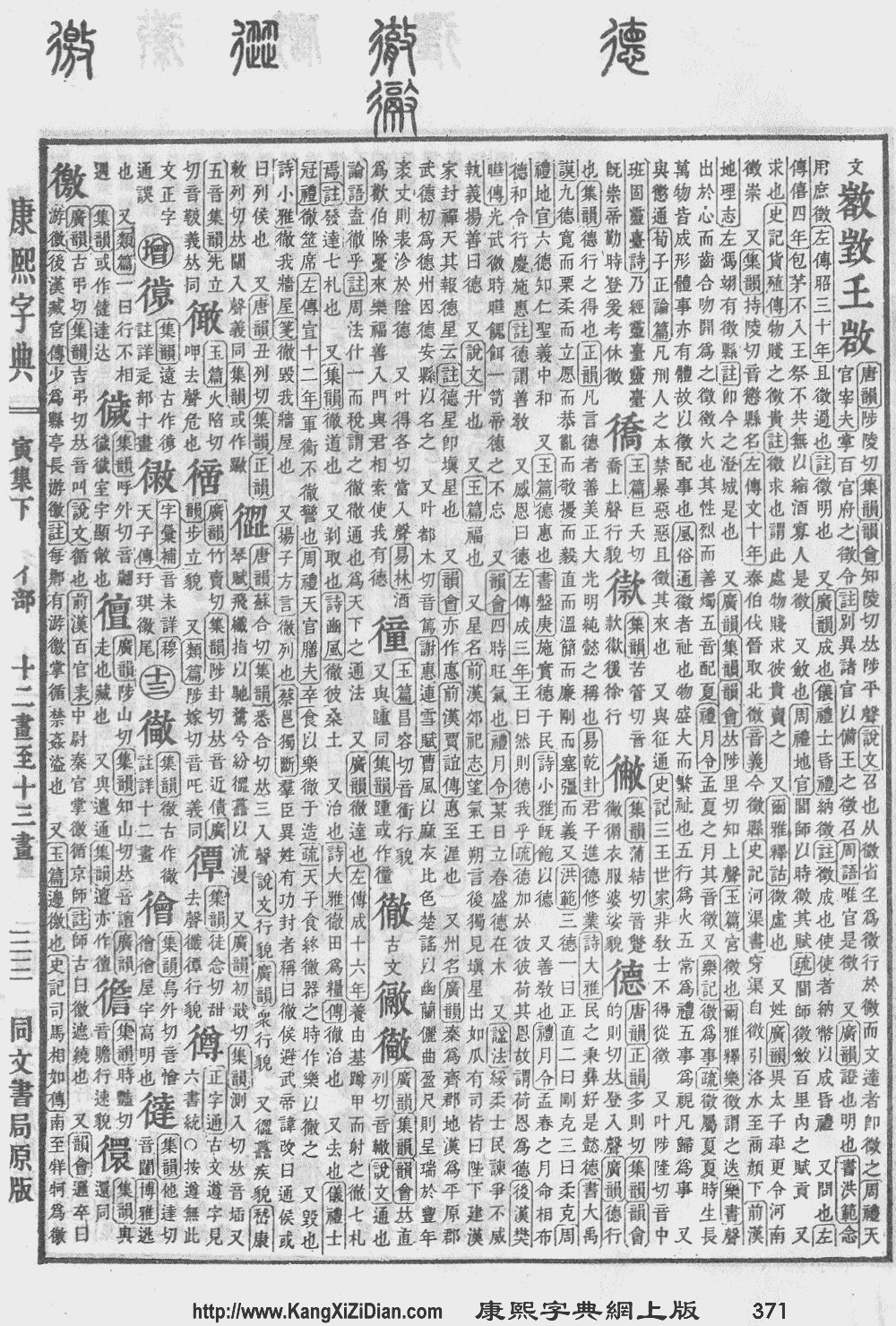
- Kangxi Dictionary: page 371, character 10
- Dai Kanwa Jiten: character 10245
- Dae Jaweon: page 698, character 6
- Hanyu Da Zidian (first edition): volume 2, page 844, character 7
- Unihan data for U+5FB9
Chinese
Lua error in Module:utilities at line 142: attempt to perform arithmetic on local 'h' (a nil value)
Glyph origin
Ideogrammic compound (會意/会意) : 彳 + 育 (“pot”) + 攵 (“hand”) – originally a hand breaking a pot.
Pot figure similar to earlier forms of 鬲, replaced/simplified in large seal script to 育 (earlier 㐬) – a child with head down, and hair/lines going down.
Etymology
The r-causative of 逝 (OC *ɦljeds) (Schuessler, 2007).
Cognate with 撤 (OC *tʰed, *ded, “to take away”), 滯 (OC *dads, “to discard; to leave over; to accumulate”) and perhaps 適 (OC *tjeɡ, “to go”).
Pronunciation
Definitions
徹
Compounds
- 不徹頭/不彻头
- 侵徹力/侵彻力
- 劉徹/刘彻
- 大徹大悟/大彻大悟 (dàchèdàwù)
- 徹上徹下/彻上彻下
- 徹侯/彻侯
- 徹夜/彻夜 (chèyè)
- 徹底/彻底 (chèdǐ)
- 徹悟/彻悟 (chèwù)
- 徹懸/彻悬
- 徹查/彻查 (chèchá)
- 徹耳/彻耳
- 徹裡徹外/彻里彻外
- 徹頭徹尾/彻头彻尾 (chètóuchèwěi)
- 徹饌/彻馔
- 徹首徹尾/彻首彻尾
- 徹骨/彻骨 (chègǔ)
- 明徹/明彻
- 曼徹斯特/曼彻斯特 (Mànchèsītè)
- 有司徹/有司彻
- 洞徹/洞彻
- 漫天徹地/漫天彻地
- 為人為徹/为人为彻
- 痛徹心腑/痛彻心腑
- 痛楚徹骨/痛楚彻骨
- 聲徹雲霄/声彻云霄
- 說徹/说彻
- 謊徹梢虛/谎彻梢虚
- 貫徹/贯彻 (guànchè)
- 貫徹始終/贯彻始终 (guànchèshǐzhōng)
- 通天徹地/通天彻地
- 通徹/通彻 (tōngchè)
- 連更徹夜/连更彻夜
- 響徹雲漢/响彻云汉
- 響徹雲際/响彻云际
- 響徹雲霄/响彻云霄 (xiǎngchèyúnxiāo)
Japanese
Etymology 1
| Kanji in this term |
|---|
| 徹 |
| てつ > てっ Grade: S |
| kan’on |
Pronunciation
- IPA(key): [te̞ʔ]
Conjugation
| Katsuyōkei ("stem forms") | ||||
|---|---|---|---|---|
| Mizenkei ("imperfective") | 徹し | てっし | te' shi | |
| Ren’yōkei ("continuative") | 徹し | てっし | te' shi | |
| Shūshikei ("terminal") | 徹する | てっする | te' suru | |
| Rentaikei ("attributive") | 徹する | てっする | te' suru | |
| Kateikei ("hypothetical") | 徹すれ | てっすれ | te' sure | |
| Meireikei ("imperative") | 徹せよ¹ 徹しろ² |
てっせよ¹ てっしろ² |
te' seyo¹ te' shiro² | |
| Key constructions | ||||
| Passive | 徹される | てっされる | te' sareru | |
| Causative | 徹させる 徹さす |
てっさせる てっさす |
te' saseru te' sasu | |
| Potential | 徹できる | てっできる | te' dekiru | |
| Volitional | 徹しよう | てっしよう | te' shiyō | |
| Negative | 徹しない | てっしない | te' shinai | |
| Negative continuative | 徹せず | てっせず | te' sezu | |
| Formal | 徹します | てっします | te' shimasu | |
| Perfective | 徹した | てっした | te' shita | |
| Conjunctive | 徹して | てっして | te' shite | |
| Hypothetical conditional | 徹すれば | てっすれば | te' sureba | |
| ¹ Written imperative ² Spoken imperative | ||||
Korean
Hanja
徹 (eum 철 (cheol))
- This term needs a translation to English. Please help out and add a translation, then remove the text
{{rfdef}}.