CHAPTER V.
AVERAGE VALUES IN A CANONICAL ENSEMBLE OF SYSTEMS.
In the simple but important case of a system of material points, if we use rectangular coördinates, we have for the product of the differentials of the coördinates



| (118) |

In this case
| (119) |

| (120) |


| (121) |

Since
| (122) |

| (123) |



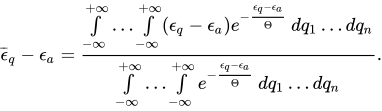
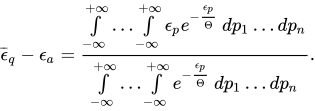
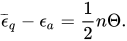
The number of coördinates is or . We have, therefore, for the average value of the kinetic energy of a system


| (124) |

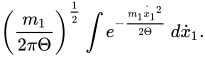
The distribution of the systems with respect to their component velocities follows the 'law of errors'; the probability that the value of any component velocity lies within any given limits being represented by the value of the corresponding integral in (121) for those limits, divided by , which is the value of the same integral for infinite limits. Thus the probability that the value of lies between any given limits is expressed by

| (125) |
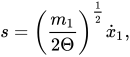

| (126) |
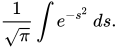


The probability that the configuration lies within any given limits is expressed by the value of
| (127) |


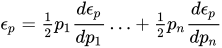
Very similar results may be obtained in the general case of a conservative system of degrees of freedom. Since is a homogeneous quadratic function of the 's, it may be divided into parts by the formula


| (128) |

| (129) |
| (130) |



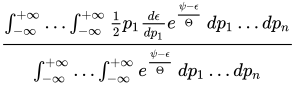
The mechanical significance of the several parts into which the kinetic energy is divided in equation (128) will be apparent if we imagine that by the application of suitable forces (different from those derived from and so much greater that the latter may be neglected in comparison) the system was brought from rest to the state of motion considered, so rapidly that the configuration was not sensibly altered during the process, and in such a manner also that the ratios of the component velocities were constant in the process. If we write




| (131) |



| (132) |


The following transformation will not only give the value of the average kinetic energy, but will also serve to separate the distribution of the ensemble in configuration from its distribution in velocity.
Since is a homogeneous quadratic function of the 's, which is incapable of a negative value, it can always be expressed (and in more than one way) as a sum of squares of linear functions of the 's.[1] The coefficients in these linear functions, like those in the quadratic function, must be regarded in the general case as functions of the 's. Let




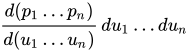

Since the 's are linear functions of the 's, when the integrations are to cover all values of the 's (for constant 's) once and only once, they must cover all values of the 's once and only once, and the limits will be for all the 's. Without the supposition of the last paragraph the upper limits would not always be , as is evident on considering the effect of changing the sign of a . But with the supposition which we have made (that the determinant is always positive) we may make the upper limits and the lower for all the 's. Analogous considerations will apply where the integrations do not cover all values of the 's and therefore of the 's. The integrals may always be taken from a less to a greater value of a .


The general integral which expresses the fractional part of the ensemble which falls within any given limits of phase is thus reduced to the form
| (134) |

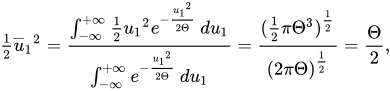
For the average value of the part of the kinetic energy which is represented by whether the average is taken for the whole ensemble, or for a given configuration, we have therefore

| (135) |
The fractional part of the ensemble which lies within any given limits of configuration, is found by integrating (184) with respect to the 's from to . This gives
| (136) |

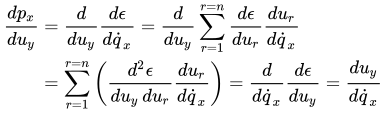
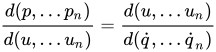
It will be observed that since the 's are linear functions of the 's, and the 's linear functions of the 's, the 's will be linear functions of the 's, so that a differential coefficient of the form will be independent of the 's, and function of the 's alone. Let us write for the general element of the Jacobian determinant. We have


| (137) |
| (138) |
| (139) |

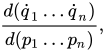
These determinants are all functions of the 's alone.[2] The last is evidently the Hessian or determinant formed of the second differential coefficients of the kinetic energy with respect to . We shall denote it by . The reciprocal determinant



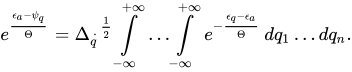
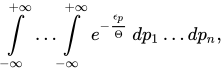
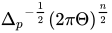
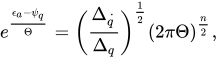
If we set
| (140) |

| (141) |
| (142) |


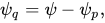
When an ensemble of systems is distributed in configuration in the manner indicated in this formula, i. e., when its distribution in configuration is the same as that of an ensemble canonically distributed in phase, we shall say, without any reference to its velocities, that it is canonically distributed in configuration.
For any given configuration, the fractional part of the systems which lie within any given limits of velocity is represented by the quotient of the multiple integral
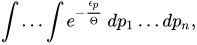


| (143) |
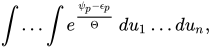
or
| (144) |

| (145) |

When systems are distributed in velocity according to these formulae, i. e., when the distribution in velocity is like that in an ensemble which is canonically distributed in phase, we shall say that they are canonically distributed in velocity.
The fractional part of the whole ensemble which falls within any given limits of phase, which we have before expressed in the form
| (146) |

| (147) |

- ↑ The reduction requires only the repeated application of the process of 'completing the square' used in the solution of quadratic equations.
- ↑ It will be observed that the proof of (137) depends on the linear relation between the 's and 's, which makes constant with respect to the differentiations here considered. Compare note on p. 12.
- ↑
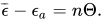
In the simple but important case in which is independent of the 's, and a quadratic function of the 's, if we write for the least value of (or of ) consistent with the given values of the external coördinates, the equation determining may be written
If we denote by the values of which give its least value , it is evident that is a homogenous quadratic function of the differences , etc., and that may be regarded as the differentials of these differences. The evaluation of this integral is therefore analytically similar to that of the integral
for which we have found the value . By the same method, or by analogy, we get
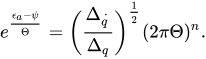
where is the Hessian of the potential energy as function of the 's. It will be observed that depends on the forces of the system and is independent of the masses, while or its reciprocal depends on the masses and is independent of the forces. While each Hessian depends on the system of coördinates employed, the ratio is the same for all systems.Multiplying the last equation by (140), we have
For the average value of the potential energy, we have
The evaluation of this expression is similar to that of
which expresses the average value of the kinetic energy, and for which we have found the value . We have accordinglyAdding the equation
we have