Turin
.svg.png.webp)
Turin is the capital of the Piedmont region and the capital of the province. It's the fourth Italian city by number of inhabitants.
Turin was particularly important in the history of the Italy: It was indeed the capital of the Savoy duchy and was the capital of Italy from 1861 to 1865.
It is an important car manufacturing city and also an important center for media (telecommunications), cinema, design and sport.
Population
Turin counts 905,780 inhabitants and its urban area has a population of 1.7 million.
Nickname
Turin city mysterious
Denonym = name of the inhabitants
Torinesi abitanti itagliani
Gastronomy = a particular dish =
vitel tonè, albese, agnoloti and ...
History

The history of Turin started in the 2nd century Before Christ, when on the banks of the river Po, the first Celtic tribe settled, looking for arable plains. These tribes were called Taurisc: hence the word "Torino" and the nickname "city of the tauri (latin for bulls)".
It became a Roman city in 28 B.C. under the name of Augusta Taurinorum. In those times, it was a military centre surrounded by walls and with a square plant. After the fall of the Roman empire, it passed under the control of the Ostrogoths, the Lombards and the Franks. This is one of the darkest historical periods of the city.
In the XV century it became the capital of Savoy; this contributed to its expansion.
In the 17th century, the city widened by buying Montferrat, which allowed to have an outlet to the sea.
In 1706, French troops besieged Turin: the siege was interrupted by the arrival of the Austrian soldiers.
In 19th century, Turin was the centre of the Italian Risorgimento with Vittorio Emmanuele II, King of the Savoy dynasty, Camillo Benso Count of Cavour, Giuseppe Garibaldi, men who managed to unify Italy. Thus, in 1861, Turin became the first capital of the Kingdom of Italy (which lasted until 1865).
Monuments
- The Mole Antonelliana
- The Egyptian museum
- The Basilica of Superga
- The Sabauda Gallery
- The Palazzo Madama
- The Palazzo di Stupinigi
Business and economy in Turin
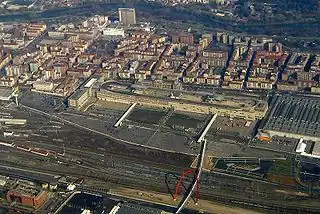
Torino is the second province in Italy for export values. Third economic center of the country, it is part of the Italian industrial triangle, made up of Milano, Torino and Genoa. The computer centre is quite developed.
Different companies were created in Turin, including:
- Fiat (which means Turin Italian Car Factory): it is the main Italian car manufacturing business. It has many known brands in its group (Ferrari, Lancia, Maserati, Jeep, Alfa-Romeo and more recently Chrysler). His base was original because its roof is a track car.
- Rai (Italian Radio-Television) is the main Italian public media group. Many important events were are covered by Rai, such as the Tour de France, the festival of San Remo and the Olympics.
- Lavazza: is the leader of coffee in Italy (48% of the market) and is also the leader the coffee machines in thee world.
- Iveco: specialised business in the production of industrial vehicles and buses. It is present in 160 countries for a turnover of (around) 10 billion.
Gallery
 Panorama of Turin seen from the Mole Antonelliana
 The Mole Antonelliana
 Basilica of Superega
 Palatine Towers
 Palazzo Madama
 Palazzo of Stupinigi
 Piazza San Carlo
 The Po