Nintendo 64
| Nintendo 64 | |||||||
 | |||||||
| | |||||||
| Manufacter | Nintendo | ||||||
|---|---|---|---|---|---|---|---|
| Generation | Fifth | ||||||
| | |||||||
| Release date | June 23 1996 in Japan and March 1st 1997 in Europe | ||||||
| Media | Game cartridge | ||||||
| Controllers | Gamepad | ||||||
| Online service | Randnet | ||||||
| Sold units | 32,93 millions | ||||||
| |||||||

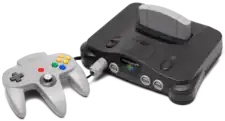
The Nintendo 64 (or N64 in abbreviated) is a home console created by Nintendo.
It is a game console from the fifth generation of video games. It was released in 1996 in Japan and in 1997 in Europe. It was no a commercial failure but the game console did not exceed his main rival, the first PlayStation. The N64 was sold at 33 millions of copies (32.93 more exactly) whereas the PlayStation was sold at 104 millions of copies (104,25 more exactly). It is one of the first game consoles to allow us to play 3D games (3 dimensions). It's also one of the first game consoles in 64 bits. The controller has a very special style, with three handles, that didn't work so well because players didn't know how to hold it well. There was 4 ports for plugging-in controllers, which means we can play in multiplayer, until 4 people. The support for games are game cartdriges, in contrast to the other game consoles of this generation. They all chose to adopt the new technology : CD-ROM. One of the most famous games of the console is Super Mario 64. The game console proposed various accessories too, but none of them knew a big success.
History
At the beginning of the 90s, the new support, CD-ROM, became very famous. Sega released an extension for his Mega Drive, which adds CD-ROM reader to the console. To counter this "attack", Nintendo associated with Sony, to create a CD-ROM reader extension for the SNES. But a disagreement between the two companies caused the discontinuation of this project. So Nintendo took his last chance and paired with Phillips for this project. This leaded Phillips to release the Phillips-CDi.
 |
Video gaming portal — All pages about video games |