Climate of Ireland
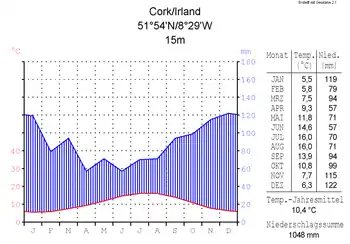
The climate of Ireland is a temperate oceanic climate. It is mild, moist and changeable with abundant rainfall and a lack of temperature extremes. The Atlantic Ocean and the warming influence of the Gulf Stream affect weather patterns in Ireland.
Ireland receives generally warm summers and mild winters.
Rainfall is the most common form of precipitation in Ireland. Rainfall is more prevalent during winter months and less so during the early months of summer.
Temperatures

The country receives generally warm summers and mild winters.
Temperatures are seldom lower than −5 °C/23 °F in winter or higher than 26 °C/79 °F in summer.
Temperatures differ regionally, with central and eastern areas tending to be more extreme. Inland areas being cooler in winter and warmer in Summer than their coastal counterparts.
The climate of Ireland is warmer than other areas on its latitude. Because it lies in the north-eastern Atlantic Ocean, and as a result is warmed by the North Atlantic Current all year. This current also ensures the coastline of Ireland remains ice-free throughout the winter
Air frost occurs frequently in the winter, with most areas seeing over 40 days of air frost every year. (Kilkenny, has an average of 53 days). Frost is rarer along the coast.
Rainfall


Rainfall is the most common form of precipitation in Ireland. Some parts of the west coast receive over four times as much rain as the east coast (like Dublin).
Rainfall is more prevalent during winter months and less so during the early months of summer.
- Western coast : the average number of "wet days" (days with more than 1 mm (0.039 in) of rain) ranges 225 days a year .As a result of south westerly winds, rainfall in the west generally averages between 1,000 and 1,250 mm (39.4 and 49.2 in). In many mountainous districts rainfall exceeds 3,000 mm (118.1 in) per year.
- Eastern coast : Receives 151 wet days a year. Most of the eastern half of the country has between 750 and 1,000 mm (29.5 and 39.4 in) of rainfall in the year.
Severe cold weather is uncommon in Ireland ; although hills and mountainous regions in the country can see up to 30 days of snowfall annually,
Sunshine
Sunshine duration is highest in the south-east of the country where there are less clouds. The sunniest months are May and June.
Winds
The far north and west are two of the windiest regions in Europe. Generally, the coast tends to be windier than inland areas; and the west tends to be windier than the east.
_(10E).svg.png.webp) |
Geography Portal — Everything about geography, continents, regions, geology, water and climate... |